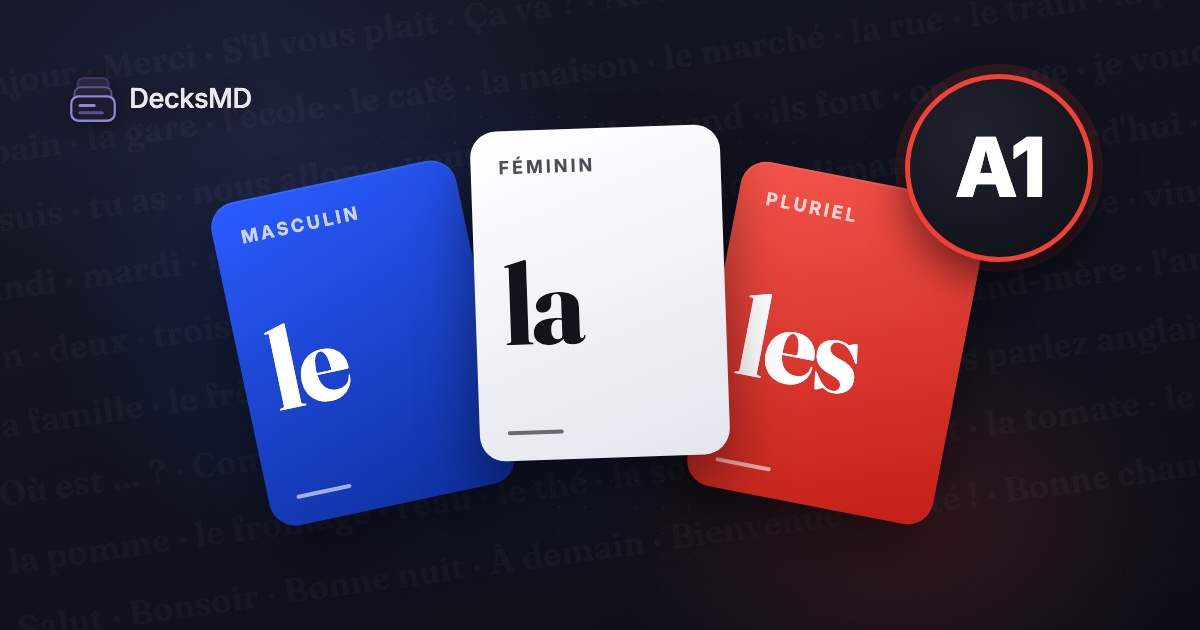
French A1 Vocabulary and Grammar
By downloading or studying this deck you agree to the deck directory terms, including the deck's licence.
French A1 flashcards for English speakers: 1,139 words with le or la, 26 grammar topics, verb forms, everyday phrases and a 182-question practice exam.
What's inside
- Vocabulary — 1,139 A1 words in 47 everyday topics, French → English and back. Every noun shows le, la or l' (with its gender where l' hides it), every adjective its feminine form, every verb its il-form and passé composé, and each word comes with an example sentence.
- Articles — le or la for every noun, plus the endings that predict the gender.
- Grammar — 26 topics explained in English with fill-in-the-gap practice: articles and the partitive, negation, questions, adjective agreement, possessives, à and de with the article, the futur proche, the passé composé and more.
- Verbs — the present tense of regular and common irregular verbs, spelling changes, pronominal verbs, the imperative and the passé composé with avoir and être.
- Phrases — 208 phrases for everyday situations: in a café or shop, asking the way, at the station, making appointments, inviting and apologising.
- Practice Exam — 182 original questions in the style of the DELF A1: messages, notices, programmes and leaflets with several questions each, everyday situations, vocabulary, grammar and forms to fill in, with an explanation for every question. There is no listening or speaking part.
4,256 cards in total.
What's inside
- Vocabulary 2,278 cards
- Articles 600 cards
- Grammar 684 cards
- Verbs 367 cards
- Phrases 208 cards
- Practice Exam Exam 119 cards
A few cards
Vocabulary
2,278 cards
Front
bonjour
Back
hello; good morning
used until the evening, then bonsoir
Bonjour, Inès ! Tu es en avance ce matin. — Hello, Inès! You're early this morning.
Front
bonsoir
Back
good evening
leaving in the evening: bonne soirée
Bonsoir, monsieur Roux, une table pour trois ? — Good evening, Mr Roux. A table for three?
Front
salut
Back
hi; bye (informal)
Salut, Karim ! Ça fait longtemps ! — Hi, Karim! It's been ages!
Articles
600 cards
Front
Which gender do nouns ending in -tion or -sion take?
Back
feminine (la)
la station, la question, la natation, l'information (f.), la télévision — no exceptions among A1 words
Front
Which gender do nouns ending in -té usually take?
Back
feminine (la)
la santé, la spécialité, la nationalité, l'université (f.) — exceptions: l'été (m.), le côté, le pâté, and le thé (spelt -thé)
Front
Which gender do nouns ending in -ette take?
Back
feminine (la)
la baguette, la fourchette, la chaussette, l'assiette (f.) — no exceptions among A1 words
Grammar
684 cards
Front
What do the accents on é, è, ê and ç tell you?
Back
French spelling uses a few marks that change how a letter sounds:
| mark | example | what it does |
|---|---|---|
| é (accent aigu) | le café, l'été | a closed sound, like ay in day without the y |
| è, ê (accent grave, circonflexe) | la mère, la fête | an open sound, like e in bed |
| ç (cédille) | le garçon, ça | c sounds like s before a, o and u |
| ë, ï (tréma) | Noël | the vowel is said apart from the vowel before it |
On à, où and là the accent changes nothing in the sound: it only tells them apart from a (has), ou (or) and la (the).
Front
Which letters at the end of a word are usually silent?
Back
Most final consonants are not pronounced: le lit, le riz, le nez, deux, trop, grand. A final -e without an accent is silent too (except in short words such as le, je, de), but it makes the consonant before it heard: grand (no d sound) → grande (d heard).
- The plural -s is silent: le livre and les livres sound different only in the article.
- The verb ending -ent is silent: ils parlent sounds like il parle.
- Final c, r, f and l are often heard: avec, bonjour, neuf, le sel. But -er at the end of a verb sounds like é: parler, manger, and so does the -er of many nouns: le boulanger, janvier.
Front
When does je become j'?
Back
Before a vowel or a mute h, some short words drop their last vowel and take an apostrophe. This is called elision, and it is not optional:
- je → j': j'habite, j'aime
- le, la → l': l'ami, l'école, l'hôtel
- ne → n', de → d', and ce → c' before est: Léo n'écoute pas. Une tasse d'eau. C'est Hugo.
- que loses its e too: qu'il, qu'elle, qu'on
- me, te, se → m', t', s': Il s'appelle Karim.
- si → s' only before il and ils: s'il vous plaît, but si elle.
Never write je aime or la école.
Verbs
367 cards
Front
Why do you say j'ai but je suis?
Back
je becomes j' when the verb form after it starts with a vowel sound: j'ai, j'aime, j'écoute.
suis, vais and fais start with a consonant, so the full je stays: je suis, je vais, je fais.
Of the personal subject pronouns, only je does this. tu always stays whole in writing: tu as, tu es.
Front
être — je
Back
je suis
Front
être — tu
Back
tu es
Phrases
208 cards
Front
, madame.
Back
Bonjour, madame.
formal · in shops, add madame or monsieur
Front
, monsieur.
Back
Bonsoir, monsieur.
formal
Front
Bonsoir le monde !
Back
Bonsoir tout le monde !
neutral
Practice Exam
119 cards
Front
Courriel de Lucie : un service
Salut !
Je suis à Lille pour mon travail jusqu'à jeudi, et mon chat Biscuit est tout seul à la maison. Demain soir, tu peux passer voir Biscuit chez moi ? La clé est chez Mme Roux, ma voisine du deuxième étage. Tu donnes des croquettes à Biscuit et tu changes son eau. Le paquet de croquettes est dans le placard de la cuisine, à côté du frigo.
Merci mille fois ! Je rapporte un petit cadeau de Lille pour toi.
Lucie
Pourquoi est-ce que Lucie vous écrit ?
Quand est-ce que vous devez aller chez Lucie ?
Où est la clé ?
Qu'est-ce que vous devez faire pour Biscuit ?
Qu'est-ce que Lucie rapporte de Lille ?
Back
Pourquoi est-ce que Lucie vous écrit ?
Demain soir, tu peux passer voir Biscuit chez moi ? Lucie is away for work and her cat is alone, so she asks you to look after it.
Quand est-ce que vous devez aller chez Lucie ?
Demain soir, tu peux passer …: tomorrow evening. Thursday is the day Lucie comes back.
Où est la clé ?
La clé est chez Mme Roux, ma voisine: the neighbour has the key. The kitchen cupboard is where the cat food is.
Qu'est-ce que vous devez faire pour Biscuit ?
Tu donnes des croquettes à Biscuit et tu changes son eau: you feed the cat and give it fresh water. The food is already in the cupboard, so you don't buy any.
Qu'est-ce que Lucie rapporte de Lille ?
Je rapporte un petit cadeau de Lille pour toi: she will bring you back a present. The cat food is already in the kitchen cupboard, and the key is with Mme Roux.
Front
Affiche de la bibliothèque des Tilleuls
La bibliothèque des Tilleuls déménage !
À partir du mardi 3 mars, la bibliothèque est au 14, place de la Fontaine, en face de la poste. Le nouveau bâtiment est plus grand, avec une salle pour les enfants et dix ordinateurs.
Inscription : apportez une carte d'identité et une photo. L'inscription est gratuite jusqu'à 17 ans. Pour les adultes, la carte coûte 8 € par an.
Horaires :
mardi, jeudi, vendredi : 13 h – 19 h
mercredi, samedi : 9 h 30 – 17 h 30
dimanche, lundi : fermé
Qu'est-ce que cette affiche annonce ?
Où est la nouvelle bibliothèque ?
Pour vous inscrire, qu'est-ce que vous apportez ?
Vous avez 35 ans. Votre carte de bibliothèque coûte combien ?
Quel jour est-ce que la bibliothèque des Tilleuls ouvre le matin ?
Back
Qu'est-ce que cette affiche annonce ?
La bibliothèque des Tilleuls déménage ! déménager means to move: from 3 March the library is at a new address.
Où est la nouvelle bibliothèque ?
au 14, place de la Fontaine, en face de la poste: opposite the post office.
Pour vous inscrire, qu'est-ce que vous apportez ?
Inscription : apportez une carte d'identité et une photo: an identity card and a photo.
Vous avez 35 ans. Votre carte de bibliothèque coûte combien ?
L'inscription est gratuite jusqu'à 17 ans, but you are an adult: la carte coûte 8 € par an.
Quel jour est-ce que la bibliothèque des Tilleuls ouvre le matin ?
Only mercredi, samedi : 9 h 30 – 17 h 30 includes the morning. On Tuesday it opens at 1 pm, and on Monday it is closed (fermé).
Front
Petites annonces au supermarché
À vendre : vélo d'enfant rouge, pour 6 à 8 ans, très bon état, 40 €. Appelez Karim après 18 h au 06 39 98 12 45.
Cherche étudiante pour garder mon fils de 4 ans le mercredi après-midi, 10 € de l'heure. Mme Benali, 06 39 98 70 31.
Cours de guitare pour débutants, chez vous ou chez moi. Le premier cours est gratuit ! Julien, 06 39 98 56 02.
Je donne un canapé gris, trois places. Vous venez chercher le canapé chez moi, au troisième étage, sans ascenseur. Sophie, 06 39 98 23 84.
Vous voulez apprendre à jouer de la guitare. Qui est-ce que vous appelez ?
Combien coûte le vélo ?
Qu'est-ce que Mme Benali cherche ?
Vous voulez le canapé de Sophie. Qu'est-ce que vous devez faire ?
Quand est-ce que vous pouvez téléphoner à Karim ?
Back
Vous voulez apprendre à jouer de la guitare. Qui est-ce que vous appelez ?
Julien gives cours de guitare pour débutants, and the first lesson is free.
Combien coûte le vélo ?
vélo d'enfant rouge … 40 €. 10 € is what Mme Benali pays per hour, and 8 is the top of the age range (pour 6 à 8 ans).
Qu'est-ce que Mme Benali cherche ?
Cherche étudiante pour garder mon fils de 4 ans: she is looking for a student to look after her son.
Vous voulez le canapé de Sophie. Qu'est-ce que vous devez faire ?
Vous venez chercher le canapé chez moi: you collect it from her flat. It is free (je donne), and there is no lift (sans ascenseur).
Quand est-ce que vous pouvez téléphoner à Karim ?
Appelez Karim après 18 h: call him after 6 pm.
Licence: Personal use Report this deck
Comments
Loading comments…