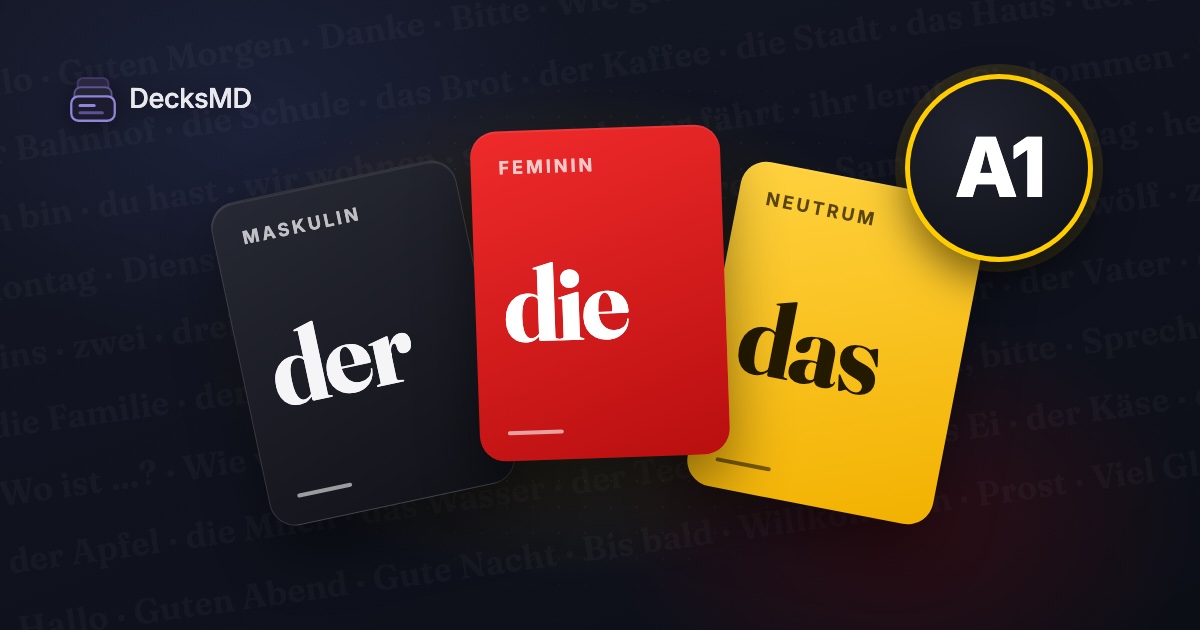
German A1 Vocabulary and Grammar
German A1 flashcards for English speakers: 1,138 essential words with der, die or das and their plurals, 24 grammar topics, verb forms and a practice exam.
What's inside
- Vocabulary: the words of the A1 exam word list plus the topic vocabulary of A1 courses, in 36 everyday topics. Nouns show their article and plural, verbs their present and perfect forms, and every word has an example sentence. Each word is asked German → English and English → German.
- Articles: der, die or das for 622 nouns, starting with 31 rules that predict the article from the ending (-ung, -heit, -chen and more).
- Grammar: 24 topics, from personal pronouns, word order and questions to the accusative and dative, modal and separable verbs, the perfect tense and comparisons.
- Verbs: sein and haben, regular verbs and verbs that change their vowel, modal and separable verbs, the imperative, the perfect, and the simple past of sein, haben and the modals.
- Practice exam: 180 questions on reading, everyday situations, vocabulary, articles, grammar and writing. Each exam draws 30 of them, with 30 minutes and a pass mark of 60%.
How to study
Start with Vocabulary and Articles, add Grammar and Verbs as you go, and take the practice exam once your reviews feel easy. Explanations are in English. Spaced repetition schedules every card, and updates to the deck keep your progress.
Prepares you for A1 exams such as Goethe-Zertifikat A1: Start Deutsch 1 and telc Deutsch A1. Not affiliated with the Goethe-Institut or telc.
By downloading or studying this deck you agree to the deck directory terms, including the deck's licence.
What's inside
- Vocabulary 2,276 cards
- Articles 653 cards
- Grammar 520 cards
- Verbs 370 cards
- Practice Exam Exam 180 cards
A few cards
Vocabulary
Front
hallo
Back
hello, hi
Hallo Tim, wie war dein Wochenende? — Hi Tim, how was your weekend?
Front
Guten Morgen
Back
good morning
Guten Morgen, Frau Klein, der Kaffee ist fertig. — Good morning, Mrs Klein, the coffee is ready.
Front
Guten Tag
Back
hello (formal, during the day)
Guten Tag, ich möchte zu Frau Becker. — Hello, I'd like to see Mrs Becker.
Front
Guten Abend
Back
good evening
Guten Abend und willkommen im Theater! — Good evening and welcome to the theatre!
Articles
Front
Which article do nouns ending in -ung take?
Back
die
die Zeitung, die Wohnung, die Übung — no exceptions among A1 words.
Front
Which article do nouns ending in -heit take?
Back
die
die Gesundheit, die Freiheit, die Kindheit
Front
Which article do nouns ending in -keit take?
Back
die
die Möglichkeit, die Süßigkeit, die Geschwindigkeit
Front
Which article do nouns ending in -schaft take?
Back
die
die Freundschaft, die Mannschaft, die Wirtschaft
Grammar
Front
Which words are the German subject pronouns?
Back
The subject pronouns stand for the person or thing doing the action:
| singular | plural | |
|---|---|---|
| 1st person | ich (I) | wir (we) |
| 2nd person, informal | du (you) | ihr (you all) |
| 3rd person | er / sie / es (he / she / it) | sie (they) |
| polite form | Sie (you) | Sie (you) |
ich is written with a small letter unless it starts the sentence.
Front
When do you say du, ihr or Sie?
Back
- du: one person you know well — family, friends, children, and usually classmates.
- ihr: two or more people you would each call du.
- Sie: polite form for one or more people — with adults you don't know, in shops, with officials, and at work with customers or a new boss until you are offered du.
Sie always takes a capital S and the same verb form as sie (they): Kommen Sie mit?
Front
How can you tell sie (she), sie (they) and Sie (polite you) apart?
Back
- sie + singular verb = she: sie wohnt (she lives).
- sie + plural verb = they: sie wohnen (they live).
- Sie with a capital letter = polite you: Wohnen Sie hier? (Do you live here?)
At the start of a sentence the capital letter doesn't help — the context tells you.
Front
Which pronoun replaces a thing in German?
Back
A thing takes the pronoun that matches its article, not it:
- der Tisch → er: Der Tisch ist neu. Er kommt aus Schweden.
- die Lampe → sie: Die Lampe ist schön. Sie ist billig.
- das Buch → es: Das Buch ist gut. Es ist spannend.
English says it every time; German follows der, die, das.
Verbs
Front
sein — ich
Back
ich bin
Front
sein — du
Back
du bist
Front
sein — er / sie / es
Back
er / sie / es ist
Front
sein — wir
Back
wir sind
Practice Exam
Front
Pharmacy sign: where can you get medicine on a Sunday?
Apotheke am Markt
Montag bis Freitag 8–18.30 Uhr, Samstag 8.30–13 Uhr. Am Mittwochnachmittag ist die Apotheke geschlossen.
Sonntags ist die Apotheke am Bahnhof für Sie geöffnet.
Back
Sonntags ist die Apotheke am Bahnhof für Sie geöffnet: on Sundays the pharmacy at the station is the open one.
Front
Note on the fridge: what should Jonas buy?
Hallo Jonas,
ich bin heute bis 19 Uhr im Büro. Kaufst du bitte Milch und Brot? Das Geld liegt im Flur auf dem Tisch. Im Kühlschrank ist noch Pizza, die kannst du warm machen.
Mama
Back
Kaufst du bitte Milch und Brot? asks Jonas to buy milk and bread. The pizza is already in the fridge.
Front
WhatsApp from Mia — true or false: Mia arrives in Hamburg at 7.30.
Hi Lena! Mein Zug hat leider eine Stunde Verspätung. Ich komme erst um halb neun in Hamburg an, nicht um halb acht. Kannst du mich dann am Bahnhof abholen? Sonst nehme ich ein Taxi. Liebe Grüße, Mia
Back
The train is an hour late, so Mia arrives at halb neun (8.30), not at halb acht (7.30).
Front
Email from the language school: when is the replacement lesson?
Liebe Kursteilnehmer,
am Donnerstag ist leider kein Deutschkurs, unsere Lehrerin ist krank. Dafür haben wir am Samstag von 10 bis 12 Uhr Unterricht. Der Raum bleibt gleich: Raum 14 im ersten Stock.
Viele Grüße, Ihre Sprachschule Lingua
Back
There is no class on Thursday; instead (dafür) there is a lesson am Samstag von 10 bis 12 Uhr. The room number is 14.
Licence: Personal use Report this deck
Comments
Loading comments…