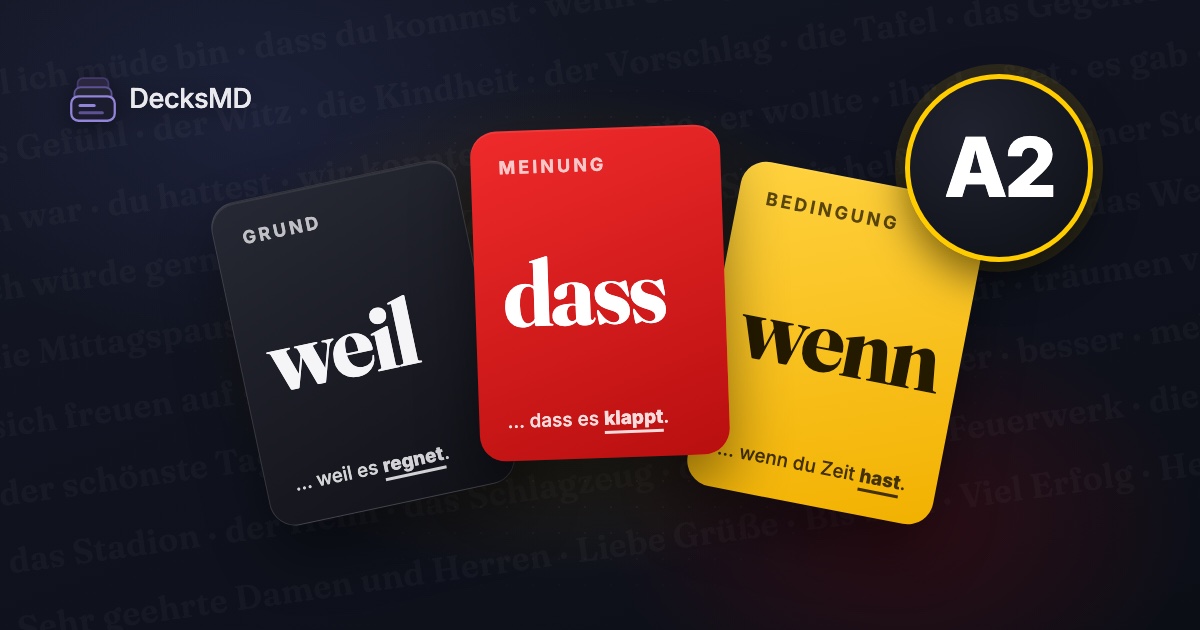
German A2 Vocabulary and Grammar
German A2 flashcards for English speakers who have finished A1: 963 new words with der, die or das and their plurals, 25 grammar topics, verb forms and a 229-question practice exam.
What's inside
- Vocabulary — 963 A2 words in 33 everyday topics, German → English and back, each with an example sentence.
- Articles — der, die or das for every new noun, plus the patterns that predict the article.
- Grammar — 25 topics explained in English with fill-in-the-gap practice: subordinate clauses (weil, dass, wenn, als, ob), relative clauses, adjective endings, comparison, the simple past, Konjunktiv II, verbs with prepositions, two-way prepositions and more.
- Verbs — the simple past of common verbs, perfect forms, reflexive verbs, verbs with prepositions and the Konjunktiv II forms.
- Practice Exam — 229 original questions in the style of the A2 exams: notices, news items, emails and adverts with several questions each, everyday situations, vocabulary, grammar, and forms and messages to fill in, with an explanation for every question.
Builds on German A1 Vocabulary and Grammar: no word or card repeats it. 3,489 cards in total.
By downloading or studying this deck you agree to the deck directory terms, including the deck's licence.
What's inside
- Vocabulary 1,926 cards
- Grammar 495 cards
- Verbs 354 cards
- Articles 561 cards
- Practice Exam Exam 153 cards
A few cards
Vocabulary
Front
das Gefühl · die Gefühle
Back
feeling
Nach der Prüfung hatte Lena ein gutes Gefühl. — After the exam Lena had a good feeling about it.
Front
sich fühlen (fühlt sich · hat sich gefühlt)
Back
to feel
Nach dem Urlaub fühlen wir uns wieder fit. — After the holiday we feel fit again.
Front
die Freude · die Freuden
Back
joy, delight
Opas Besuch war eine große Freude für alle. — Grandpa's visit was a great joy for everyone.
Front
froh
Back
glad
Wir sind froh, dass der Umzug endlich vorbei ist. — We're glad the move is finally over.
Grammar
Front
Where does the verb go after weil?
Back
weil (because) starts a subordinate clause. Its conjugated verb moves to the very end, and a comma separates the reason from the main clause:
- Ich bleibe heute im Bett, weil ich Fieber habe.
- Mein Vater ist sauer, weil sein Auto schon wieder kaputt ist.
Everything else in the reason — subject, time, objects, nicht — stays between weil and the verb.
Front
If weil and denn both mean because, what is the difference?
Back
The meaning is the same; only the word order changes:
- denn sits in position 0 and changes nothing, so the verb stays in position 2: …, denn die Heizung funktioniert nicht.
- weil sends the verb to the end: …, weil die Heizung nicht funktioniert.
A denn clause always comes second, after the main clause. In everyday speech weil is much more common.
Front
What happens to a modal, a perfect or a separable verb after weil?
Back
The conjugated part goes last, right after the infinitive or the participle. A separable verb is written as one word again:
- modal verb: …, weil ich morgen früh arbeiten muss.
- perfect: …, weil Jana ihren Ausweis vergessen hat.
- separable verb: …, weil das Spiel gleich anfängt.
So the end of the clause reads infinitive or participle first, then the conjugated verb.
Front
What changes when the sentence starts with weil?
Back
The whole weil clause then fills position 1. The main clause continues with its verb straight after the comma, and the subject follows — verb, comma, verb:
- Weil der Zug Verspätung hat, nehmen wir ein Taxi.
- Weil Opa Geburtstag hatte, sind wir nach Kiel gefahren.
denn can't do this: a denn clause always comes second.
Verbs
Front
What are the six simple past forms of machen?
Back
A regular verb keeps its stem, adds -te and then a personal ending. The ich and er / sie / es forms are identical and end in -te, just like hatte:
| person | machen | wohnen |
|---|---|---|
| ich | machte | wohnte |
| du | machtest | wohntest |
| er / sie / es | machte | wohnte |
| wir | machten | wohnten |
| ihr | machtet | wohntet |
| sie / Sie | machten | wohnten |
The wir and sie / Sie forms are always the same.
Front
Why is it er öffnete and es regnete, with -ete?
Back
The extra -e- you know from the present tense (er arbeitet, er öffnet) also appears in the simple past, in every person:
- stem ending in -t or -d: arbeiten → ich arbeitete, reden → wir redeten
- stem ending in -m or -n after another consonant: öffnen → er öffnete, regnen → es regnete
When the consonant before -m or -n is l, r or h, the plain -te stays: lernte, wohnte.
Front
machen — simple past (ich / er)
Back
ich machte · er machte
Front
sagen — simple past (ich / er)
Back
ich sagte · er sagte
Articles
Front
Which article do nouns ending in -ur usually take?
Back
die
die Natur, die Kultur, die Reparatur — exceptions: das Abitur, der Flur. Words in -eur are der (der Friseur).
Front
Which article do nouns ending in -age take?
Back
die
die Garage, die Etage, die Massage — pronounced as in French. Exception: das Image.
Front
Which article do nouns ending in -ade take?
Back
die
die Limonade, die Schokolade, die Marmelade
Front
Which article do nouns ending in -anz or -enz take?
Back
die
die Distanz, die Konferenz, die Konkurrenz — short words are different: der Tanz.
Practice Exam
Front
Phone call at work: a caller asks for your colleague Mrs Brandt, who is in a meeting. What do you say?
Back
Soll sie Sie später zurückrufen? offers a call back after the meeting. Gestern cannot go with a call that has not happened yet, and nie wieder anrufen is rude.
Front
Your name is Lisa Brenner and you answer the phone at work for the printing company Hartmann Druck. How do you start the call?
Back
Give the company and your name, then offer help with Wie kann ich Ihnen helfen? The option Was können Sie für mich tun? asks the caller to help you, and Was willst du? is far too rude for a business call.
Front
Phone call at work: you did not catch the caller's surname. How do you ask politely?
Back
Könnten Sie bitte Ihren Nachnamen buchstabieren? politely asks the caller to spell their surname. Meinen Nachnamen would be your own name, and Was? Noch mal, aber langsam! is rude.
Front
The coffee machine you bought in a shop last week has stopped working. You take it back. What do you say?
Back
You explain the problem and politely ask for a replacement: Könnte ich bitte eine neue bekommen? Buying the broken machine again makes no sense, and calling the machines Müll is rude.
Licence: Personal use Report this deck
Comments
Loading comments…