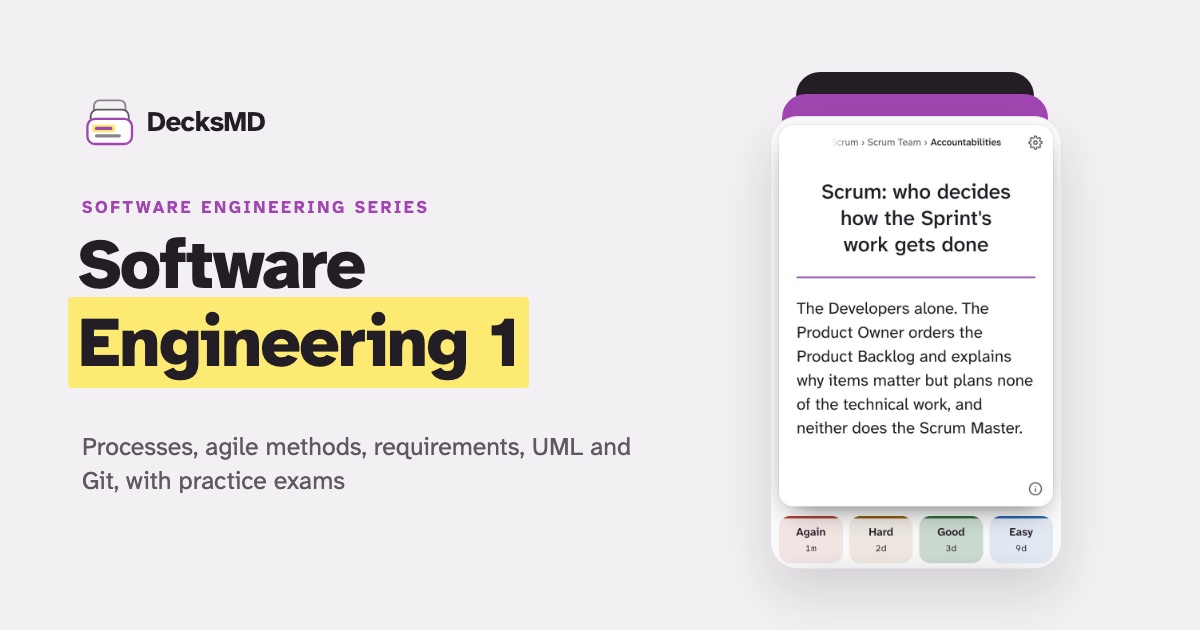
Software Engineering 1
By downloading or studying this deck you agree to the deck directory terms, including the deck's licence.
Software engineering flashcards for the first bachelor's course: software processes, agile methods, requirements engineering, modelling with UML and version control, with 17 exam-style exercises.
What's inside
- Foundations and Life Cycles — software processes, life-cycle models and process improvement.
- Agile Methods — the Agile Manifesto, Scrum (2020 guide), Lean and Kanban, Extreme Programming, scaling and agile planning.
- Requirements Engineering — elicitation, prioritisation, EARS, use cases, user stories, traceability and goal models.
- Modelling with UML — use case, class and object, sequence, activity, state machine, component and deployment diagrams, OCL and data-flow diagrams.
- Version Control — configuration management, Git's object model, branching and merging, pull requests and semantic versioning.
- Practice — 17 exam-style exercises with marking schemes and model answers, including UML modelling tasks.
Every card is written in our own words with our own examples, and every worked example, trace and model answer is checked by script. The Practice deck is an exam: it draws three exercises at random, and you grade your answers against each marking scheme. The Scrum cards draw on the Scrum Guide 2020 by Ken Schwaber and Jeff Sutherland (CC BY-SA 4.0).
1,226 cards in total.
What's inside
- Foundations and Life Cycles 159 cards
- Agile Methods 206 cards
- Requirements Engineering 244 cards
- Modelling with UML 372 cards
- Version Control 228 cards
- Practice Exam 17 cards
A few cards
Foundations and Life Cycles
159 cards
Front
Software engineering: definition
Back
The discipline of building and evolving software in teams, under limits of money and time, with methods whose results can be planned, checked and repeated.
core · Compare the definition in ISO/IEC/IEEE 24765, which SWEBOK quotes.
Front
Software engineering and programming: the difference
Back
Programming produces working code. Software engineering also covers what lets software last and grow: requirements, design, teamwork, quality assurance and change over years of use.
core · "Programming integrated over time": Winters, Manshreck and Wright 2020.
Front
Software engineering and computer science: the difference
Back
Computer science explains what computation can do and at what cost: algorithms, languages, limits. Software engineering is about a team delivering, and then evolving for years, a system people depend on, within a budget and a deadline.
core
Agile Methods
206 cards
Front
Manifesto for Agile Software Development: origin
Back
Seventeen practitioners of lightweight methods, among them the authors of XP and Scrum, wrote it in February 2001 at Snowbird, Utah. They agreed on shared values and principles, not on a common method.
core · Beck et al. 2001, agilemanifesto.org. Also represented: DSDM, Crystal, feature-driven and adaptive software development.
Front
In short, the four value pairs put people over process and tools, over documentation, collaboration over contracts, and responding to change over the plan.
Back
In short, the four value pairs put people over process and tools, working software over documentation, collaboration over contracts, and responding to change over the plan.
core · Beck et al. 2001; the full text is at agilemanifesto.org.
Front
In short, the four value pairs put people over process and tools, working software over documentation, over contracts, and responding to change over the plan.
Back
In short, the four value pairs put people over process and tools, working software over documentation, collaboration over contracts, and responding to change over the plan.
core · Beck et al. 2001; the full text is at agilemanifesto.org.
Requirements Engineering
244 cards
Front
Requirement (software): definition
Back
A statement of a behaviour the software must show, a quality it must have or a limit it must respect, so that it solves a stakeholder's problem and can be accepted.
core · SWEBOK quotes IEEE's formal definition, which also covers conditions set by a contract or a standard.
Front
Requirements engineering: definition
Back
Finding out, agreeing, writing down and checking what a system must do and be, and then controlling how those requirements change for as long as the system is in use.
core · Tip: it has two halves, developing the requirements and managing them, and both last as long as the system does.
Front
Requirements activities, from elicitation to validation: in what order they run
Back
In loops, not a line: writing a requirement down raises questions for the stakeholders, a review reopens the analysis, and a prototype shows what nobody had said. Each loop covers the work coming next, broad at the start and detailed where building is about to begin.
core · Tip: the life cycle decides how much of this happens before design starts; even a waterfall project loops back when reviews find gaps.
Modelling with UML
372 cards
Front
Model (software engineering): definition
Back
A simplified representation of a system, existing or planned, made for a purpose: it keeps the elements and properties that matter for the questions it must answer and leaves the rest out.
core · Tip: say what a model is for before drawing it; that decides what goes in.
Front
Abstraction (modelling): definition
Back
Choosing what a model keeps by the questions it must answer: details that don't change the answers are dropped, and similar things may be merged under one concept. Different purposes give different abstractions of the same system.
core · Abstraction in design (modules, information hiding): → Software engineering 2.
Front
By Stachowiak, a model an original, reduces it to the attributes that seem relevant, and is pragmatic: made for certain users, a certain time and a certain purpose.
Back
By Stachowiak, a model maps an original, reduces it to the attributes that seem relevant, and is pragmatic: made for certain users, a certain time and a certain purpose.
depth · Stachowiak 1973, "Allgemeine Modelltheorie": the mapping, reduction and pragmatic features.
Version Control
228 cards
Front
Configuration management (software): definition
Back
The discipline that lets a team say at any time exactly what its product consists of, version by version, and how it got that way: no part changes without an agreed decision, and every change can be traced.
core · IEEE 828-2012, ISO 10007:2017. 12207 technical management: → Foundations and life cycles: "ISO/IEC/IEEE 12207: its four process groups".
Front
A parking-permit supplier ships a patch that brings back a bug fixed three months earlier: the configuration management failure behind it
Back
The patch was built from versions that predate the fix: nobody had a reliable record of which version of each part made up the current release, so the build picked up an older one and the old bug returned.
core · A regression of this kind is a classic sign of missing configuration management.
Front
Configuration management and version control: the difference
Back
Version control records the history of files and lets people change them in parallel. Configuration management decides which items are controlled, who may approve changes, what each release contains and how that is checked; version control is one of its tools.
core
Practice
17 cards
Front
Exercise 1: Two projects at a water utility
A regional water utility starts two software projects at the same time.
- Dosing control: the software for a new chlorine-dosing unit at its treatment plant. A wrong dose can make thousands of people ill, and the health authority approves the software only on the evidence of documented requirements, design and tests. The dosing rules come from a national regulation that hasn't changed in eight years. Five engineers work on it, each with years of experience in control software, in a department used to signed-off procedures.
- Customer portal: a website where households submit meter readings, see their bills and report leaks. Marketing wants to try ideas on real customers and expects to change about half of the planned features after the first months. Eight developers work on it: six recent graduates and two seniors from a web agency who are used to short cycles.
Some activities of the two projects:
- (a) choosing the supplier of the dosing pumps' controllers and agreeing the contract;
- (b) the portal team's monthly review of what could go wrong and what to do about it;
- (c) running the build servers and test environments that both projects use;
- (d) installing the finished dosing software on the plant's control computers and handing it over to the operators;
- (e) drawing up the portal's plan for its first year: the releases, their dates and the effort each needs;
- (f) keeping enough staff with the right skills, including training new hires.
1.1 Place each project on Boehm and Turner's five factors, and say which home ground each factor points to. (4 points)
1.2 Recommend a life-cycle approach for each project, and say how the portal team can deal with its weak factor. (3 points)
1.3 Place each activity (a) to (f) in its ISO/IEC/IEEE 12207 process group. (3 points)
Back
1.1 Place each project on Boehm and Turner's five factors, and say which home ground each factor points to. (4 points)
4 points: dosing: criticality, dynamism and culture point to plan-driven (1) · dosing: the small, experienced team points to agile on size and personnel (1) · portal: size, criticality and dynamism point to agile (1) · portal: six graduates out of eight point to plan-driven on personnel, and the culture is mixed or leans agile (1)
Model answer:
- Dosing control: size, five people: agile. Criticality, lives at stake: plan-driven. Dynamism, rules unchanged for eight years: plan-driven. Personnel, all experienced: agile. Culture, used to procedures: plan-driven. Three of the five factors point to plan-driven, criticality among them.
- Customer portal: size, eight people: agile. Criticality, money and inconvenience at worst: agile. Dynamism, half the features expected to change: agile. Personnel, mostly graduates: plan-driven. Culture: marketing and the two seniors want short cycles, the graduates bring no habits yet, and the utility around them works by procedure: mixed, or leaning agile.
The portal belongs in the agile home ground, with personnel as its weak factor.
1.2 Recommend a life-cycle approach for each project, and say how the portal team can deal with its weak factor. (3 points)
3 points: dosing: a plan-driven model such as the V-model, whose documents and test levels give the authority its evidence (1) · portal: iterative and incremental, for example Scrum with releases to real customers every few weeks (1) · for the graduates: pair them with the two seniors and add explicit rules, such as a Definition of Done, a coding standard and reviews (1)
Model answer: The dosing unit suits a plan-driven model such as the V-model. Its requirements are stable, and the authority wants every phase's results written down and checked, which the V's paired test levels supply. The team can still iterate inside a phase, for example by prototyping the dosing algorithm. The portal's main risk is building features customers don't want, so it suits an iterative and incremental process such as Scrum, with early releases. Agile methods lean on experienced people, so the team adds structure where the graduates need it: pairing with the seniors, a written coding standard, reviews and a strict Definition of Done.
1.3 Place each activity (a) to (f) in its ISO/IEC/IEEE 12207 process group. (3 points)
3 points: (a) agreement and (d) technical (1) · (b) and (e) technical management, since each steers one project (1) · (c) and (f) organizational project-enabling, since each serves every project of the utility (1)
Model answer: Groups, with the 12207 process each falls under:
- (a) agreement: acquisition; the supplier handles its side under supply;
- (b) technical management: risk management;
- (c) organizational project-enabling: infrastructure management;
- (d) technical: transition;
- (e) technical management: project planning;
- (f) organizational project-enabling: human resource management.
Only (d) works on the product itself. (b) and (e) steer one project; (c) and (f) serve every project of the utility, so they belong to the organisation.
Front
Exercise 2: A rental-desk app that grew
A chain of six ski-rental shops had a student build a tablet app for its rental desks in 2023, as a quick try-out of whether staff would use tablets at all. The staff liked it, so that winter it went into all six shops as it was. Since then the student, now the chain's only developer, has added whatever shop managers ask for on the phone, editing the code directly on the live server. There are no written requirements and no automated tests, and nobody knows which shop runs which version. Each change now takes longer than the last; in February a fix to the deposit calculation broke the return screen in two shops on a Saturday. The owner has hired two more developers and asks for "a proper process".
2.1 Which way of working has the chain followed since 2023, and why does each change now take longer? (2 points)
2.2 Name three process problems in the story, and give a remedy for each. (3 points)
2.3 The owner wants to know within six months whether the new process works. State a GQM goal in the template, then two questions with one metric each, and say what the figures must be compared with. (4 points)
Back
2.1 Which way of working has the chain followed since 2023, and why does each change now take longer? (2 points)
2 points: code-and-fix, on a throwaway try-out that became the product without being rebuilt (1) · each fix was fitted in without restructuring or tests, so the code gets harder to understand and every change riskier (1)
Model answer: The app was built to answer one question, whether staff would use tablets, and was then put to work unchanged: a throwaway prototype turned into the product. Since then the student has coded and fixed whatever came in. Each fix went wherever it worked, with nothing to show what else it might break, so the structure decays and each change costs more than the one before, as the Saturday failure shows.
2.2 Name three process problems in the story, and give a remedy for each. (3 points)
3 points: one point per problem with a fitting remedy, such as: requests arrive by phone and are built at once, so keep one list that the owner orders (1) · code is edited on the live server without tests, so use version control, a test copy and automated regression tests that run before each release (1) · nobody knows which shop runs which version, so tag every release and record which version each shop runs (1)
Model answer: For example:
- Phone requests are built at once, unrecorded and unweighed: collect them in one list that the owner orders, and decide what goes into each release.
- The code is changed on the live server: keep it in version control, try changes on a test copy and release them deliberately.
- There are no tests: write automated regression tests, starting with the deposit and return rules, and run them before every release.
- Nobody knows what runs where: tag each release and record which version each shop has, which is configuration management.
- All the knowledge sits with one person: pair the new developers with the student and review each other's changes.
- The prototype was never rebuilt: plan time to restructure the riskiest parts, such as the deposit calculation.
2.3 The owner wants to know within six months whether the new process works. State a GQM goal in the template, then two questions with one metric each, and say what the figures must be compared with. (4 points)
4 points: a goal that names the object, purpose, quality issue and viewpoint, such as analysing the release process to evaluate the failures it causes in the shops, from the shop staff's view (1) · a question on whether releases break things in the shops, with a metric such as failures reported per release (1) · a second question, such as how fast requests reach the shops, with a metric such as days from request to release (1) · the metrics are also collected for a period before the change, such as the months just before it or the same season a year earlier, so that there is something to compare with (1)
Model answer:
- Goal: analyse the release process (object) in order to evaluate it (purpose) with respect to the failures it causes in the shops (quality issue), from the viewpoint of the shop staff (viewpoint).
- Q1: How often does a release break something in a shop? M1: failures that shops report within a week of a release, per release.
- Q2: Does the new process slow down what managers ask for? M2: the median number of days from a request to the release that contains it.
The shops' phone notes give both figures for the months before the change. Without them, a drop after the change can't be told apart from a quiet season.
Front
Exercise 3: Scrum at a veg-box company
FreshCrate delivers weekly vegetable boxes and builds its own ordering app. It says it uses Scrum. Its last Sprint went like this:
- The head of sales and the head of logistics share the Product Owner job. Each keeps a list of wanted features, and the team works from one list in one Sprint and from the other in the next.
- The Scrum Team has seven developers and a Scrum Master. A separate QA team tests each Sprint's work in the week after it.
- Sprints last four weeks. If items aren't finished, the Sprint is extended by a few days.
- The Daily Scrum takes place on Mondays and Thursdays only, because most developers work from home on the other days.
- In Sprint Planning, the Scrum Master picks the items for the Sprint, because she knows the developers' capacity best.
- In week three, the head of sales put a "Christmas voucher" item straight onto the Sprint Backlog and asked for it by Friday.
- An item counts as done once its code is merged.
- In the Sprint Review, the team shows slides to the two heads, who ask questions; afterwards neither list changes.
- The Sprint Retrospective is skipped whenever the Sprint has been extended.
3.1 Leaving the Christmas voucher aside, which three problems concern the accountabilities and the make-up of the Scrum Team, and what does the Scrum Guide 2020 expect instead? (3 points)
3.2 What is wrong with the events, and what does the guide expect instead? (4 points)
3.3 The head of sales wants the Christmas voucher by Friday. Who decides, and what are the options under the guide? (2 points)
3.4 Write a Definition of Done for FreshCrate that makes a finished item part of a usable Increment. (2 points)
Back
3.1 Leaving the Christmas voucher aside, which three problems concern the accountabilities and the make-up of the Scrum Team, and what does the Scrum Guide 2020 expect instead? (3 points)
3 points: two people share the Product Owner job with two lists, where the guide wants one person ordering one Product Backlog (1) · testing sits in a separate team, where the Scrum Team is cross-functional and its Developers test their own work (1) · the Scrum Master picks the Sprint's items, where the Developers choose them after talking it through with the Product Owner (1)
Model answer:
- Product Owner: one person, not a committee, accountable for one ordered Product Backlog for the product. The two heads can ask for features, but one of them, or someone else, must order everything in a single list.
- Cross-functional team: the Scrum Team has every skill needed to produce a usable Increment each Sprint, so the QA testers join it as Developers.
- Choosing the work: in Sprint Planning the Developers choose what to take on from the Product Backlog, after talking it through with the Product Owner. The Scrum Master can coach them, but doesn't choose for them.
3.2 What is wrong with the events, and what does the guide expect instead? (4 points)
4 points: Sprints are extended, where a Sprint has a fixed length and unfinished items go back to the Product Backlog (1) · the Daily Scrum is held twice a week, where the Developers meet for it on each working day of the Sprint, always at the same hour and place (1) · the Sprint Review is a slide show that changes nothing, where it is a working session that inspects the Increment and adapts the Product Backlog (1) · the Retrospective is skipped, where every Sprint ends with one, and an overrun Sprint needs it most (1)
Model answer:
- Sprint: four weeks is allowed, but the length is fixed: the Sprint ends on time, and unfinished items return to the Product Backlog.
- Daily Scrum: 15 minutes on each working day of the Sprint, always at the same hour and place. Working from home changes the place, not the rhythm; with two a week, the Developers go days without re-planning toward the Sprint Goal.
- Sprint Review: a working session in which the Scrum Team and stakeholders inspect what was built and agree what to do next, which shows up as changes to the Product Backlog. Slides with no outcome waste it.
- Sprint Retrospective: it concludes every Sprint. Dropping it exactly when the Sprint went wrong hides the problems the team most needs to look at.
3.3 The head of sales wants the Christmas voucher by Friday. Who decides, and what are the options under the guide? (2 points)
2 points: the Product Owner decides where the item goes in the Product Backlog, and the head of sales can't add to the Sprint Backlog, which belongs to the Developers (1) · it joins the current Sprint only if the Developers can fit it by renegotiating scope with the Product Owner without endangering the Sprint Goal; otherwise it waits for the next Sprint Planning (1)
Model answer: The head of sales can ask, but the item is ordered by the Product Owner, one person once the problem in 3.1 is fixed, against everything else in the Product Backlog. The Sprint Backlog is the Developers' own plan, so nobody else adds to it. If the voucher is more valuable than work still open in this Sprint, the Developers and the Product Owner may swap scope, as long as the Sprint Goal stays reachable and quality doesn't drop. If it can't be fitted, it is a candidate for the next Sprint Planning.
3.4 Write a Definition of Done for FreshCrate that makes a finished item part of a usable Increment. (2 points)
2 points: conditions beyond merging, such as code reviewed, automated tests written and passing, tested within the Sprint and deployed to a test environment or ready to release (1) · stated so that anyone can check each condition with yes or no, for every item (1)
Model answer: For example: the code is reviewed by a second developer; unit and acceptance tests are written and pass in the build; the item is tested by the Developers, testers included, within the Sprint; it is deployed to the staging app; no defect of the highest severity is open; the help pages are updated. With the testers inside the team, the testing that used to follow a week later now happens before an item counts as done.
Licence: Personal use Report this deck
New Software engineering decks by email
Hear when they arrive, or tell us which deck you need.
Comments
Loading comments…